The Bible We Wish We Had And The Hermeneutic Of Denial

Sunday, November 22, 2015

Peter Enns has spoken of differentiating between the Bible we wish we had, and the Bible we actually do have. We might expect that if God were to write a book for us, it ought to contain perfect, unchanging, absolute truth which is plainly understandable. That is the way we think the Bible ought to be, similar to how we assume that if God is good and powerful then the world ought to be a place where there was no suffering or injustice.

But there is a big difference between the way we wish the world was, and the way we wish the Bible was, and the way they actually are. As Enns writes in The Bible Tells Me So

"This kind of Bible— the Bible we have— just doesn’t work well as a point-by-point exhaustive and timelessly binding list of instructions about God and the life of faith... When we try to squish the Bible’s diverse voices into one voice, we are no longer reading the Bible we have— we are distorting it and cutting ourselves off from what it has to offer us."

Nowhere is this more true than in how conservative Evangelicals approach the issue of homosexuality. The assumption is that we can take what the Bible has to say about homosexuality, and trust that this can be taken as a timeless and binding view that we must uphold and defend, regardless of what science and life tell us, regardless of what our conscience tells us, regardless of what others tell us first hand. We are "safe" to discount others, discount our own moral conscience, discount what we find in our lives, and instead trust in the Bible here.

This was exactly the hermeneutical approach taken by conservative Christians in their defending of the perpetuation of institutionalized slavery in the United States. However, rather than finding a better way to approach Scripture based on understanding the mistakes of our past, conservatives continue to use this same approach of unquestioning obedience. 

To do this, they need to deny that there ever was a problem with how their Christian forefathers used that same approach to the Bible to justify slavery. For example, Tim Keller makes the claim that, "there was never any consensus or even a majority of churches that thought slavery and segregation were supported by the Bible.” The implication is that supporting slavery was always a minority view in the church. As I have pointed out before, that is simply not true. The reality is, the church has a long history of endorsing slavery based on the authority of the Bible, including the New Testament, which says that Christians can own slaves.

Others have argued that because slavery in ancient Rome was not based on race that this somehow makes it okay. This of course ignores the fact that slavery has always been characterized by dehumanizing violence, including rape. There is simply no way to paint slavery of any time as morally acceptable. Not the slavery of the Old Testament, not the slavery of Rome, and not the slavery endorsed by the church for centuries and centuries.

In his book Every Good Endeavor, Keller writes that, "Many critics of Christianity simply assume that the Bible wrongly endorsed slavery and that therefore it may be wrong about other things it teaches. Actually, biblical theology destroyed the coercive heart of the institution of slavery within the Christian community and finally led Christians to abolish the inevitably oppression-prone institution itself."

What Keller does not say is that the way of reading the Bible so that it leads to the abolition of slavery is a categorically different approach than the one he takes in regards to homosexuality. If we read the Bible as a timeless and eternal guide for God's morals, then we must conclude that either God wants slavery or that the Bible is wrong and cannot be trusted. That's one way, and it is a dead end.

In contrast, we have the way of reading the Bible that does lead to the abolition slavery. This involves learning to read the Bible on a trajectory, accepting that the Bible does not always provide us with timeless eternal truths that we must unquestioningly perpetuate and defend, but instead requires that we question and grow and develop -- moving in some cases beyond where the Bible is stuck in the morally wrong assumptions of the religious and political culture of the time. 

What we find is not a timeless and eternal blueprint, but a view that is on the one hand limited by the blinders of the surrounding culture, and at the same time giving us clues of how we need to grow beyond that, towards transforming our world to more and more take on the values of Jesus' politics and economy where, as Paul says, "There is division of slave or free... for you are all one in Christ Jesus" (Gal 3:28).

If we want to read the Bible like that in regards to slavery, then we need to do the same in regards to homosexuality. Now, of course just because the Bible is wrong in endorsing slavery does not automatically mean that it is wrong in condemning homosexuality. However, it does necessarily follow that we cannot simply claim in regards to homosexuality that "this is what the Bible plainly teaches" and defend that. We need to instead look at the evidence in our lives and world, and learn how to morally discern what is good in connection with life and reality.

However, the predominate "party-line talking points" approach of conservative Evangelical leaders today (such as Keller, Fuller Seminary, Christianity Today Magazine, and so on) in regards to homosexuality is to not do that at all. Their strategy in the culture war is to instead utterly ignore everything but what "the Bible clearly teaches." This approach is an exact mirror of how Christians in the past defended slavery in the United States.

Conservative Christians like Keller continue to make the same mistake today with the issue of homosexuality that their forefathers made in the past with slavery. Nothing has changed in how the Bible is approached. Nothing is learned from the past. Instead we have a hermeneutic of denial -- denying the reality of the past and the harm it caused, and denying the harm that same approach of unquestioning obedience continues to cause today.

It seems clear to me that the priority is not on caring for the oppressed and the marginalized, but rather defending the way we wish the Bible was. Conservative evangelicals wish the Bible were a book they could unquestioningly look to for timeless and absolute moral guidelines, and have so based their faith on that assumption that to question it is to question the very inspiration of Scripture and with it the very foundation of their faith.

That's why they so vigorously defend it, they feel threatened. It's understandable that people who feel threatened become blind to how they are hurting others. It's understandable, but it's not okay. In focusing on defending their system of the Bible they wish they had, the focus is placed on defending that fictional view, at the expense of hurting the very people Jesus said we should especially care for.

Labels: , , ,

Homosexuality and Why You Can’t Remove Love From Exegesis: An Appeal to Tim Keller and Matthew Vines

Sunday, August 16, 2015

With the major shift in our country’s laws affirming marriage equality, homosexuality has become a hot-button issue within Evangelicalism. We have seen both Evangelicals who are speaking out in favor of acceptance of their LGBT brothers and sisters (often losing their jobs in the process), and at the same time we have seen a doubling-down from Evangelical institutions and leaders in rejecting this shift.

Those Evangelicals who see homosexuality as wrong tend today to argue this point based on the “authority of Scripture alone,” meaning they present no actual evidence that would lead them to conclude there is anything harmful with people in loving same-sex relationships, other than that “the Bible says so.” In other words, their position —and this is by far the most common position among conservative Evangelicals today— is essentially that it does not matter what you or I think, it does not matter what we can observe, it does not matter what gay people tell us... all that matters is what the Bible says. The Bible condemns it, that settles it. All we need to do, they argue, is to look to what Scripture clearly teaches about homosexuality, and regard this as the final and authoritative word on the matter.

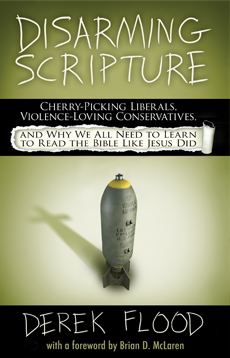
As I demonstrate in Disarming Scripture, there is a major flaw in this kind of reasoning. Using this exact same approach to the Bible has lead Christians in the past to support both slavery and child abuse based on the “authority of Scripture.” Let me clarify here that first of all, I am not referring to spanking, but what would be considered criminal child abuse—beating children bloody with a whip or rod. This type of child abuse was common among Christians (as well as the broader culture) for centuries, and was justified based on the “authority of Scripture.” Likewise, slavery was justified for centuries on the “authority of Scripture.” We should not have any romanticized notions of what slavery was like in the ancient world—it was brutal and inhumane. Slaves in the ancient world were not only commonly beaten, but raped by their masters.

We can see from these examples that this approach to Scripture—which is the predominant approach taken by Evangelicals today—has led in the past to justifying things that are terribly damaging, immoral, and abusive.

Now, that of course does not mean that just because some things in the past were hurtful and immoral (like slavery and child abuse) that therefore anything we object to in the Bible is automatically wrong. However, it absolutely does mean that we cannot rely on “what the Bible plainly says” alone, detached from any sort of moral evaluation, ignoring our conscience, ignoring people telling us they are being hurt. If we do not question, and in fact ignore our conscience screaming at us “this feels really wrong,” and ignore everything we can observe about how humans work, including people saying to us “this is hurting me!” pressing on despite all of that “standing on the authority of Scripture” this is a virtual guarantee that we will arrive at abusive and hurtful interpretations.


Evangelicals Who Can’t Remember Their Past

So how do conservative Evangelicals respond to this? One example is Tim Keller who in his “The Bible and Same Sex Relationships: A Review Article” in response to books by Matthew Vines and Ken Wilson, attempts to deny that Christians ever endorsed slavery. Keller writes,

“Up until very recently, all Christian churches and theologians unanimously read the Bible as condemning homosexuality. By contrast, there was never any consensus or even a majority of churches that thought slavery and segregation were supported by the Bible.”

Keller cites a number of authors to back up this claim. For example he claims that “historians such as Mark Noll have shown the 19th century position some people took that the Bible condoned race-based chattel slavery was highly controversial and never a consensus.” However, this completely misrepresents what Noll actually says. Of course there was not a consensus. That’s why we had a Civil War. The point is not that Keller can find progressive-leaning American Christians who opposed slavery. The point is that those who read the Bible like Keller does now were the ones who supported slavery then. Listen to what Noll actually has to say on the issue,

“[F]or over thirty years Americans battled each other exegetically on the issue, with the more orthodox and the ones who took most seriously the authority of Scripture being also the ones most likely to conclude that the Bible sanctioned slavery.” (Noll, Civil War as Theological Crisis, 115)

As Noll illustrates with multiple case studies, it was much easier for those on the pro-slavery side to make a direct appeal to the “plain meaning” of Scripture. Theirs was the stronger and more self-evident biblical argument, Noll observes. Yet that very focus on “correct” interpretation led them to commit acts of unspeakable cruelty and barbarity— all done in the name of submitting to the authority of Scripture.

Further, as Matthew Vines points out in his response to Keller's review, this is not only a matter of slavery in America, but slavery practiced by Christians for centuries upon centuries. Slavery was vigorously defended by Martin Luther, John Calvin, and Jonathan Edwards. Keller’s characterization of history is just flat out wrong here. The reality is, the church has a long history of endorsing slavery based on the authority of the Bible. The same is true of the church’s endorsement of what we would now regard as criminal child abuse, again based on the “authority of Scripture.” The issue here is that history shows us that reading the Bible in this unquestioning authoritarian way has led Christians to defend and maintain these deeply hurtful and immoral practices.

As the saying goes, “Those who cannot remember the past are doomed to repeat it.” What Keller is not facing is that Evangelicals such as himself continue to read their Bibles today in regards to homosexuality in precisely the same way conservative Christians read it in the past in regards to slavery. Nothing has changed in this regard. The hermeneutic of unquestioning obedience is identical. Evangelicals have apparently learned little from their past in regards to how they read the Bible.

I'll never forget the first time I visited the Gedaechtnis-Kirche (Church of Remembrance) in the city center of Berlin. The pastor, seeing that I was an American, came to me and said, "I want to ask your forgiveness for what my people have done." I was only 22 at the time, and pastor couldn't have been much older, meaning that at the time of WWII he was not even born. Yet here he was asking for  forgiveness on behalf of his country. As an American that never left me. It was so... what's the word I'm looking for?... Christian. Yet in my own country,  a country where its citizens often refer to it as "a Christian nation," such a statement seems nearly unthinkable. I wish that we American Christians could take responsibility for the past sins of our country like that young German pastor did. I wish we Evangelicals could learn to care less about defending our doctrinal camp or our Bibles, and a little bit more about the marginalized and the "least" among us. I wish that was not so foreign to us.


Reading Morally

Referring to 19th century Christian abolitionists, Noll writes, “[T]he stronger their arguments based on general humanitarian principles became, the weaker the Bible looked in any traditional sense. By contrast, rebuttal of such arguments from biblical principle increasingly came to look like a defense of Scripture itself” (45). The same could be said today. The reason Evangelicals like Keller so adamantly oppose acceptance of same-sex relationships is because they see this as tantamount to the defense of the authority of Scripture. Likewise, the strongest arguments of those Evangelicals who are gay affirming such as Matthew Vines or Ken Wilson are those based on humanitarian principles—noting the harm that is resulting among gays due to the rejection and condemnation they experience.

The overwhelming majority of social scientists and mental health practitioners today would maintain that there is simply no evidence that same-sex relationships are destructive or harmful in and of themselves. Conversely, what we can observe, as far as harm is concerned, is that statistically the LGBT community has a higher rate of drug abuse, mental illness, and suicide than the larger population— alarmingly higher in fact.

The reason is quite clear: the rejection they experience. Being kicked out of their homes, hiding who they are, being threatened and hated, etc. can easily make a person sick, depressed, broken, and even drive them to suicide. As their voices have begun to be heard, we have seen story after story of how gay and transgender kids have felt hated, at times even hating themselves.

This matters tremendously. This is what we need to pay attention to. This needs to factor into how we read the Bible. As I say repeatedly in  Disarming Scripture, if we recognize that our particular interpretation and application of Scripture is leading to observable harm, this necessarily means that we need to stop and reassess our course. Scripture, as Jesus read it, needs to lead us to love God, others, and ourselves. If we find that it is leading instead to causing harm then we are getting it wrong.

I appreciate very much the work of Vines and Wilson. My concern, however, is that the approach taken by left-leaning Evangelicals like Vines continues to affirm the authority of Scripture but argues that we have just misread it. The basic argument is that we just need to understand the context, or know the Greek better, and we will see that the New Testament is actually not condemning homosexuality.

Vines says his book God and the Gay Christian “envisions a future in which all Christians come to embrace and affirm their LGBT brothers and sisters— without undermining their commitment to the authority of the Bible” (3). That’s certainly a laudable goal. However, the problem is that this ultimately plays into the hands of conservatives like Keller who want to restrict the conversation to solely “what the Bible says,” and discount any discussion of what is good and loving based on paying attention to our life experience and relationships. It acts as if the problem was simply one of correct exegesis, and that all we need to do is find that right reading to settle the matter. Again, this leaves out the necessity of a moral evaluation of the text, and connecting our reading of Scripture to our life experience.

In his book, Vines tells how his father changed his mind “persuaded by biblical scholarship, historical evidence, and reason” (19). This surely plays a vital role, but I would like to underline (and I think this is something Vines knows) that the reason for his father’s change of heart was surely not because of exegetical arguments alone, but also because his father loves his son. Love is not a factor that can be removed from exegesis. When love is there, those exegetical arguments can build a bridge. For all the parents and loved ones of LGBT Christians, the exegetical arguments in Vine’s book could be the glue that works towards love and reconciliation. But when those same arguments are encountered by someone like Keller who feels the need to defend Evangelicalism’s doctrinal front-line, those appeals to relationship and love are simply discounted, and the focus is placed solely on “what the Bible has to say.”

For such Evangelicals, the issue of homosexuality is tied to their understanding of the authority of Scripture. However, with the issues of slavery and child abuse that understanding of “the authority of Scripture” has been shown to be deeply flawed, leading to advocating things deeply hurtful and wrong. That immoral understanding of Scripture has to change. We Evangelicals need to find a way of reading the Bible that leads us to Jesus-shaped love, not a way of reading that is divorced from love and relationship.

Labels: , , , ,

This website and its contents are copyright © 2000 Derek Flood, All Rights Reserved.
Permission to use and share its contents is granted for non-commercial purposes, provided that credit to the author and this url are clearly given.